


Sachet vs Stick Pack Packaging: Key Differences, Pros & Cons
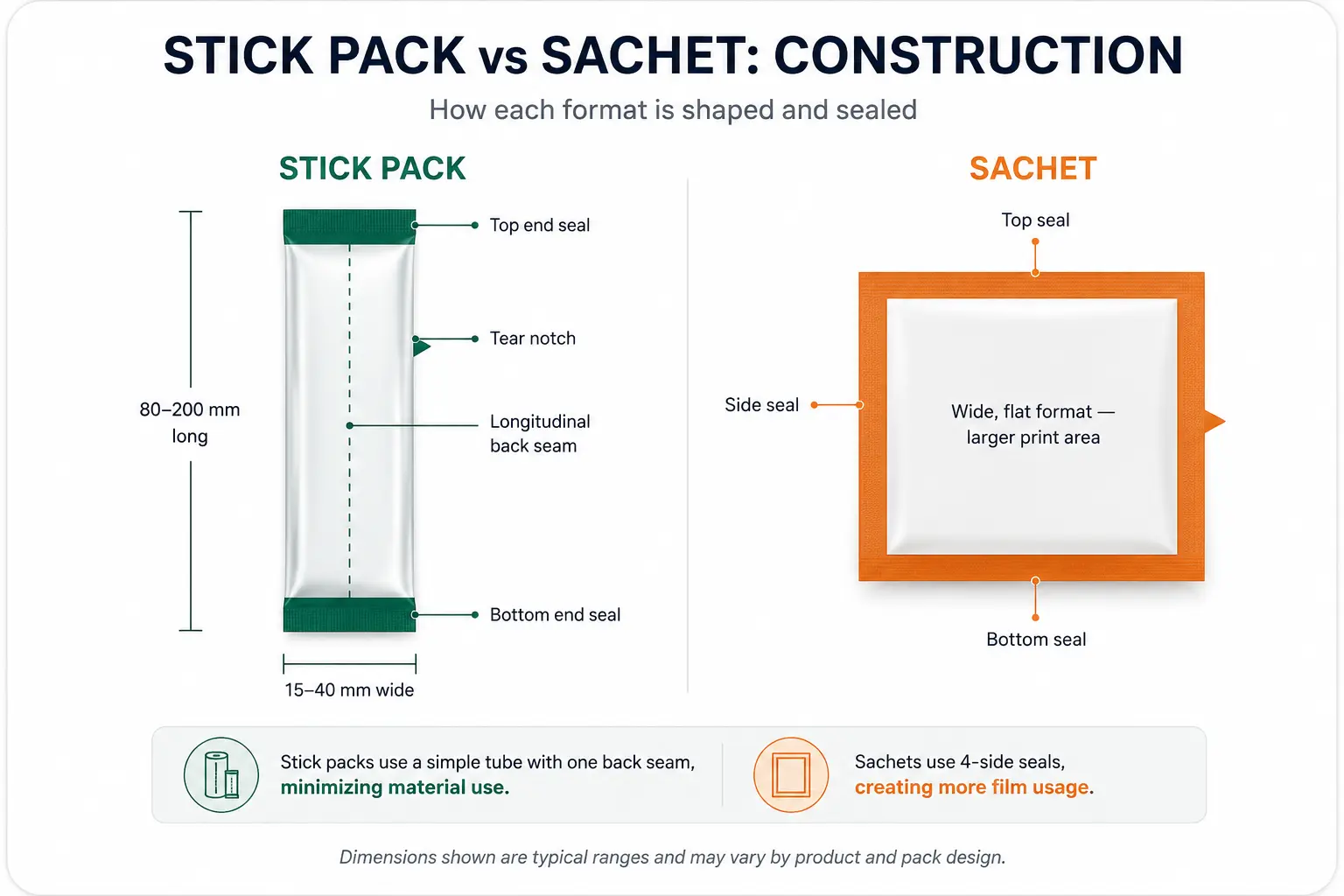
Quick answer: A stick pack is a long, narrow tube sealed on one side and both ends, built for powders and thin liquids with precise dosing. A sachet is a flat pouch sealed on three or four sides, offering more flexibility for powders, liquids, creams, and gels, plus a larger surface for branding. Stick packs typically use 15–40% less film per unit; sachets typically offer more product and printing space per pack.
Choosing between sachet packaging and stick pack packaging can significantly impact a product’s market success. These two formats are both single-serve flexible packaging, but they differ in shape, sealing, material use, and ideal applications. This guide compares them directly so you can pick the right format — and the right machine — for your product.
What Is a Stick Pack?
A stick pack is a flexible, narrow, elongated package sealed longitudinally and at both ends, forming a tube. This design is effective for dispensing powders, liquids, and gels in controlled amounts. Typical dimensions run about 15–40 mm wide and 80–200 mm long, though exact sizes vary by manufacturer and product.
Stick packs are common for instant coffee, energy drink mixes, nutritional supplements, and condiments. Their tubular shape allows precise, controlled dispensing while the laminated film provides a strong barrier against moisture, oxygen, and light — important for preserving sensitive products.
The main advantage of stick packs is precise dosing, which matters most in pharmaceutical and nutraceutical applications where accurate, consistent amounts are critical.
What Is a Sachet?
A sachet is a small, flat pouch sealed on three or four sides. Unlike the narrow, tubular stick pack, a sachet offers a more flexible format that accommodates a wider range of product types, including powders, liquids, creams, and granules.
The flat, rectangular shape gives sachets a larger surface area for branding and product information — useful in industries like pharmaceuticals and cosmetics where labeling requirements are strict. Sachets can also be produced in a wide range of sizes and shapes, and often include easy-tear notches or perforations for consumer convenience.
Sachet vs Stick Pack: Side-by-Side Comparison
| Attribute | Stick Pack | Sachet |
|---|---|---|
| Shape | Long, narrow tube | Flat, rectangular pouch |
| Sealing | Longitudinal seam + 2 end seals | 3-side or 4-side seal |
| Typical size | 15–40 mm wide × 80–200 mm long | Flexible, generally wider format |
| Film use per unit | Lower — up to 15–40% less than a comparable sachet | Higher — more film and backing per unit |
| Best for | Free-flowing powders, granules, thin liquids | Powders, liquids, creams, gels, larger portions |
| Printable surface | Narrow, limited branding space | Wide, more room for labeling and branding |
| Sealing method | Heat sealing | Heat, cold, or ultrasonic sealing |
| Typical industries | Instant coffee, drink mixes, supplements, sugar | Pharma, cosmetics, sauces/condiments, sample sizes |
| Machine type | Stick pack machine | 4-side-seal / sachet machine |
Bag Styles & Sealing Methods
The most visible difference is shape and sealing. Stick packs are long and narrow, sealed longitudinally and at both ends to form a tube — a design that packs tightly and dispenses in a controlled stream, ideal for high-density packing of powders and liquids.
Sachets are flat and sealed on all four sides, offering a broader surface for labeling and more efficient flat-stacking for bulk sale or multi-pack kits.
Sealing technology differs too. Stick packs almost always use heat sealing for a strong, tamper-evident closure. Sachets can use heat sealing, cold sealing (for heat-sensitive products like certain pharmaceuticals and cosmetics), or ultrasonic sealing for an especially strong, leak-proof seal. Both formats can be finished with easy-tear notches or perforations for one-handed opening.
Material Use & Cost
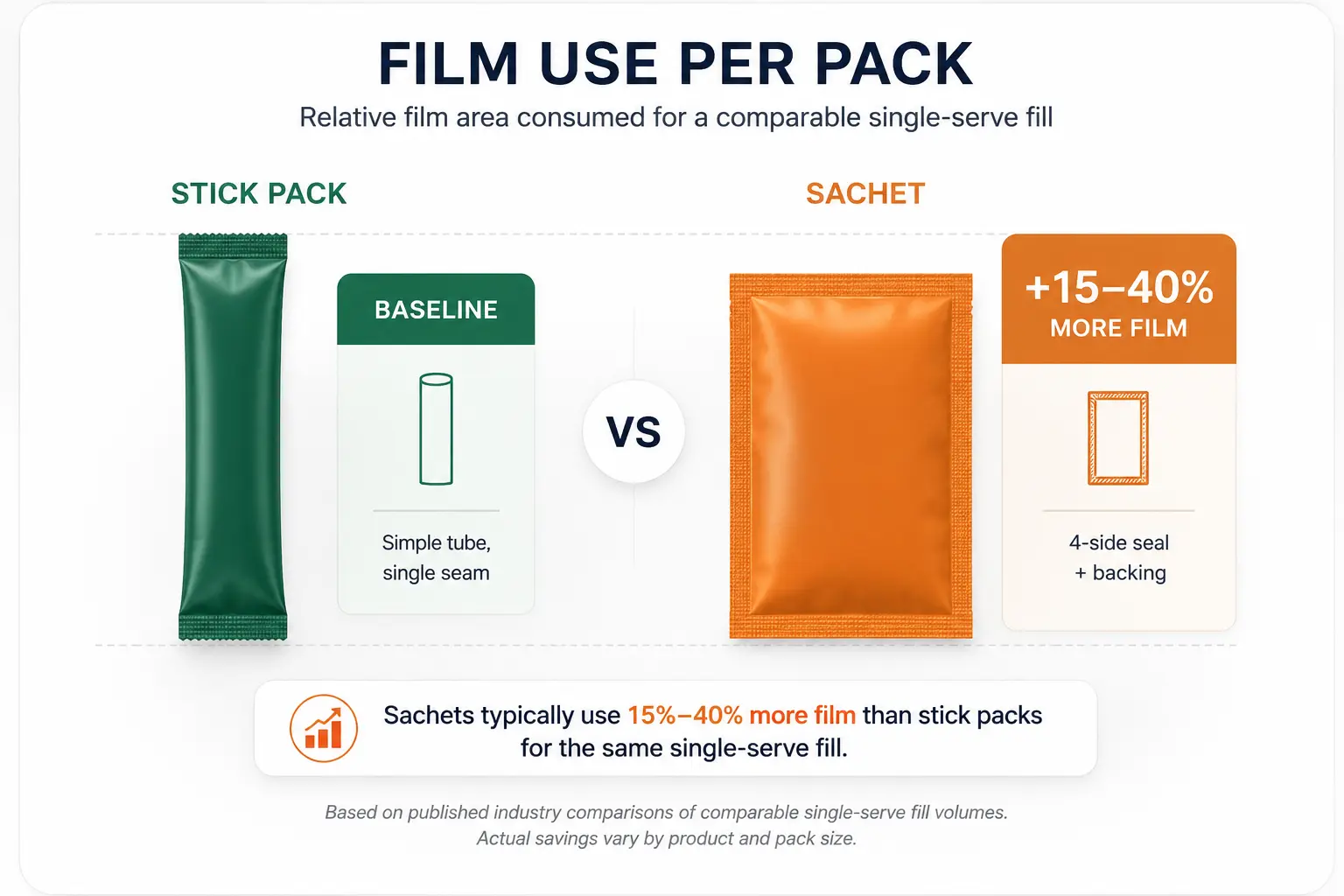
Because a stick pack is a simple tube, it generally uses 15–40% less packaging film per unit than a comparable sachet, which uses more material to seal on three or four sides and often needs extra backing. Fewer layers and less film per pack can lower material cost and waste at high volumes.
That said, “cheaper" depends on your product and fill volume. Sachets can be more economical for products needing a larger dose or more label space, since one sachet may replace what would otherwise take a larger or multi-compartment stick pack. Get quotes based on your actual fill weight and target volume rather than assuming one format is universally cheaper.
Industries & Applications
Stick packs are common in food and beverage for instant coffee, drink mixes, and sugar, where the slim, portable format appeals to on-the-go consumers. In pharmaceuticals and nutraceuticals, stick packs are used for oral rehydration salts, vitamins, and dietary supplements where precise, single dosing matters.
Sachets are widely used across pharmaceutical, cosmetic, and food industries. Their larger surface supports detailed usage instructions and regulatory information, and their flat form is well suited to cosmetic sample sizes (creams, lotions, shampoos) and food single-serve portions (condiments, sauces, spices).
Benefits of Sachet Packaging
- Versatility — sachets can be produced in a wide range of sizes and shapes for powders, liquids, creams, and more.
- Branding space — the flat, broad surface supports detailed labeling and stronger shelf branding.
- Cost-effectiveness at scale — the simple flat design supports efficient high-volume production.
- Product protection — strong barrier properties against moisture, air, and contaminants when sealed correctly.
Benefits of Stick Pack Packaging
- Convenience — the slim, elongated shape is highly portable for on-the-go use.
- Controlled dispensing — the narrow tube allows precise pouring or squeezing, critical for accurate dosing.
- Space efficiency — compact size takes up less shelf space and is easier to store and transport.
- Consumer appeal — a modern, sleek shape that stands out in a competitive market.
Which Should You Choose?
- Packing a free-flowing powder or thin liquid for on-the-go, single-dose use? Stick pack is usually the better fit.
- Packing a cream, gel, thicker liquid, or a product needing detailed labeling? Sachet is usually the better fit.
- Minimizing film cost per unit at high volume is the priority? Stick pack generally uses less material.
- Maximizing branding and label space is the priority? Sachet gives you more surface to work with.
- Not sure yet? Send Fodapack your product and target fill weight — we’ll recommend the format and machine that fits.
Ready to move forward? Tell Fodapack your product, target fill weight, and production volume, and we’ll recommend the right format — sachet or stick pack — along with a tailored machine quote.
What Is the Difference Between a Sachet and a Stick Pack?
Which Is Cheaper to Produce, a Sachet or a Stick Pack?
Can Sachets Be Used for Liquids?
Can Stick Packs Hold Liquids, or Only Powder?
Which Is Better for Branding, Sachet or Stick Pack?
Is a Stick Pack a Type of Sachet?
Which Packaging Machine Do I Need, Sachet or Stick Pack?
About Us
Since 1996, Fodapack has been a specialized manufacturer of high-quality packaging machines, delivering customized stick pack, sachet, pillow type, flow pack, and wet wipe solutions to clients worldwide. With proven expertise in design, production, and commissioning, we serve industries across the globe. Learn more About us and view our Certificates.
Packaging Types
Solutions
Membership


